If you’re trying to decide between dental implants and dentures, chances are you’re after a pair of teeth that feel rock-solid when you eat and talk. And you want a tooth replacement solution that you won’t be questioning a couple of months down the road.
To be honest, the answer is rarely as simple as “implants or dentures.” There’s a whole spectrum of options to consider, and the middle ground is a lot more important than most people realize.
Implants vs Dentures in 60 seconds
| Option | What it is | Best for | Tradeoffs |
| Traditional dentures | Removable teeth that sit on the gums | Fastest, lowest upfront cost | Can slip, may need adhesive, and refits |
| Dental implants | Posts are placed in the jaw to support new teeth | Strong stability and bite feel | Surgery, healing time, and higher upfront cost |
| Implant-supported dentures (snap-in) | Removable denture that “snaps” onto implants | More security without going fully fixed | Attachments need upkeep |
| All-on-4 (fixed full-arch) | Fixed teeth supported by four implants | Full-arch, non-removable feel | Cleaning is different, a bigger investment |
If your denture moves and it drives you nuts, pay attention to implant-supported options. They are designed to reduce slipping without forcing you into a fully fixed bridge right away.
What Dentures (aka artificial teeth) Can Do And Where They Fall Short
Dentures can be a good fit when you want a removable option, or you need replacement teeth in a hurry after an extraction. A well-made denture will restore your smile and give you back some facial support, and you can even upgrade it over time as your mouth heals.
The problem is that they don’t always hold up over the long haul. Gums and jawbone change over time, so a denture that fits fine at first can start to rub, rock, or let food sneak underneath. Adhesives can be a big help, but they can’t make up for a denture that no longer fits right.
Conventional Denture Types You Might Hear About
A full denture replaces an entire arch of missing teeth. If you only have a few missing teeth, then a partial denture fills in those gaps using your remaining healthy, natural teeth to anchor to. An immediate denture gets placed right after an extraction, but often needs to be relined as your mouth settles.
What Dental Implant Surgery Changes
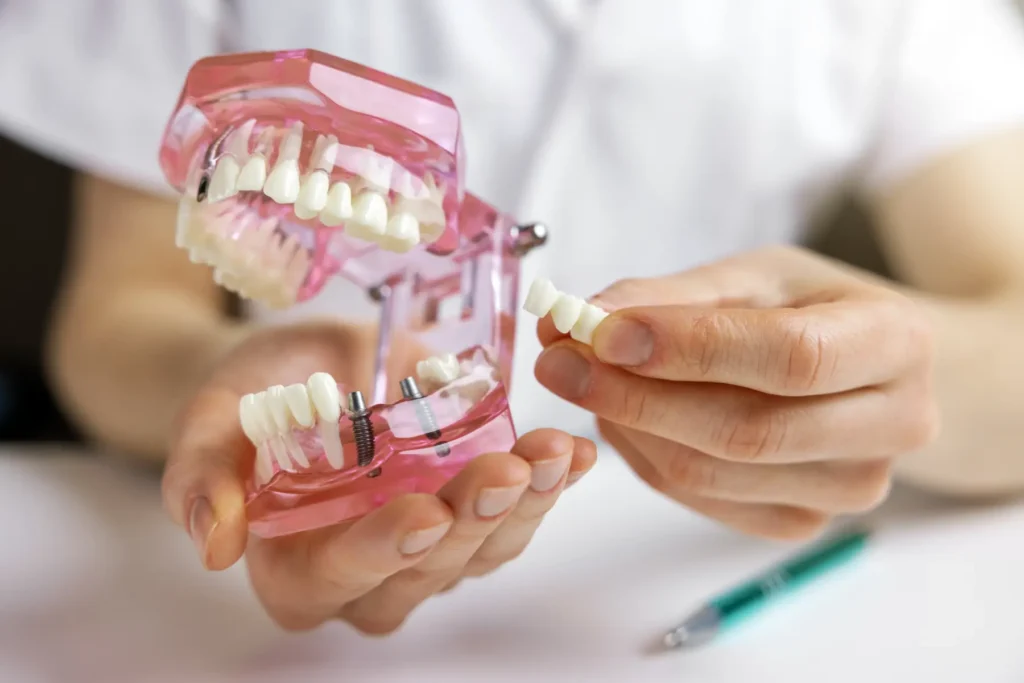
A dental implant is essentially like a replacement root. It gets placed in the jawbone, and then your body heals around it, which is why they can feel so much more stable when you’re chewing once treatment is all done.
And implants also give you a lot more options. You can support one tooth, several teeth, or even a denture that locks in. So even if you start with dentures, you can still fit implants into the plan later.
Prep steps: Scans, Bone grafting.
Most implant plans start with some diagnostics like a 3D scan to check out your bone, your bite, and your nearby anatomy. This helps your clinician place the implants in places that are safe and smart, and design teeth that match your bite rather than just your smile.
If you have a lot of bone loss, you might need to do some grafting or other prep work before you can get implants. That doesn’t mean you’re “not a candidate”, it just means you’ll need a longer, more straightforward plan and a more realistic conversation about what to expect and how much it will cost.
Implant-Supported Dentures That Come In Fixed And Removable Options.
Implant-supported dentures are designed for people who want the convenience of a denture without all the constant movement. They’re especially helpful for lower dentures, which tend to be a lot less stable than upper dentures.
Snap-In Overdentures
Snap-in dentures click onto implants with some attachments. You can remove them to clean them, and they tend to feel a lot more solid than a traditional denture. The attachments do wear out over time, so keep in mind that maintenance is part of the package and should be factored into your plan.
“How many implants do you need?” really depends on your bone and your bite. For a lot of lower snap-in plans, two implants are a pretty common number, and upper arches usually need more support.
Fixed Full Mouth Dental Implant Options (All-On-4 and Similar)
Fixed dental implant dentures just stay in place, and you clean under them with some special tools. All-On-4 is one common method that uses four implants to support a fixed set of teeth. It’s not necessarily “better” out of the box; it’s just more fixed and more involved.
A Simple Way to Choose: 5 Decision Factors
Try to keep your decision grounded in the real world:
- Stability: Do you want zero movement, or just a big upgrade from what you’ve got now?
- Maintenance: Are you okay with taking out a denture every day, or do you prefer fixed teeth and special cleaning?
- Timeline: Can you wait out the healing phase, or do you need a faster interim solution?
- Anatomy and health: Your bone, gums, and medical history all shape what’s safest and realistic.
- Value: Compare long-term costs, including relines, repairs, and attachment replacement.
If you are traveling for care, starting with a remote review can help you avoid wasted trips. At Dental Algodones, we offer a Free Virtual Diagnostic so you can compare options and get a rough plan in place before you book.
What the Process Looks Like For Traveling Implant Patients

Implants and dentures both sound like “new teeth,” but the timeline often catches people off guard. Dentures can be delivered pretty quickly, while implants usually need some time to heal before the final teeth are locked in.
Here’s a travel-friendly way to think about it:
Records and diagnosis: an exam and some scans or impressions; implant planning may involve a CBCT.
Treatment day: extractions, implant placement, denture delivery, or a combination.
Healing and finals: integration time (if implants), then final teeth and bite adjustments.
Expect some small tweaks during the last phase. That’s just part of getting the fit right and how you end up with a comfortable bite.
Costs Without the Shock: A Fair Comparison
Implants typically cost more up front than traditional dentures, but to compare them fairly, you can’t just look at one number. What really matters is what you’re actually getting and how follow-up work is handled.
When comparing quotes, a clear breakdown is key. You want to know what’s included and how any after-the-fact work is handled.
A good quote will typically break down the costs into these categories:
- Diagnostics (exam, imaging, scans to get a clear picture of what you’re working with)\
- Surgical items (implants, extractions, grafting if you need it)\
- Restorative items (abutments, attachments, crowns, bridges, denture materials)\
- Temporaries and adjustments (what you wear whilst healing, relines, bite refinements)\
- Warranty and maintenance (what’s included and what you need to do to keep things running smoothly)
Here at our office, we start at $750 for a standard titanium implant and $280 for dentures, and we confirm the total after an exam and imaging. Full-arch options have their own pricing, think All-on-4 from $8,900 for a single arch, and snap-in dentures from $3,430 per arch, though these prices vary depending on what materials you’re using and the needs of your case.
Why Los Algodones is a Great Destination For A Dental Trip
Cancun and Los Algodones are the two places that often come up when talking about dental work in Mexico, but if you’re looking for a quick and easy trip, then Los Algodones is the way to go. It’s designed for short trips and border crossings that don’t take up too much of your time.
The fact that it’s so easy to get to and from Los Algodones is a big part of what makes it so appealing. You can park on the U.S. side, walk across, and be done in a day if you want. And because it’s so easy to get to and from, seeing the dentist multiple times is a whole lot easier to manage.
Why Dental Algodones for implants and dentures
When you’re choosing between dentures and implants, what you really want is a team of people who know their stuff and can work with you to create a plan that makes sense for you. And that means a team that plans carefully, explains things clearly, and keeps a record of your whole treatment process so you can see what’s going on and why.
Here at Dental Algodones, we work with a team of specialists with 20+ years of experience in implantology. We use the latest technology to give you the best results possible, think CBCT imaging and CAD/CAM milling, aimed at minimising the number of little surprises and tweaks as you go.
What’s the Next Step If You’re Pondering DA for your Dental Health?
Don’t make a final decision based on a single blog post. What’s right for you depends on a whole lot of factors: your bone structure, your bite, the state of your gums, your overall oral health, and finally, what you want your life to be like after treatment.
If you want a good starting point, try sharing:
- Some photos of your smile and the bits that are bothering you
- Any recent X-rays (even a clear phone photo will do)
- What is your main goal (is it stability, easier chewing, fewer removals, or just a fixed feel that you can rely on)
From there, one of our clinicians can work out the practical next steps and tell you whether you might be suitable for a traditional denture, a snap-in overdenture, or maybe a fixed full-arch option is the way to go.
Frequently Asked Questions
Are implant-supported dentures removable?
Yes, some of them are removable (the snap-in overdentures kind), and some are fixed (the full-arch bridges kind). Removable kinds come out for cleaning, while fixed teeth stay in place and require a bit of special care to keep them looking their best
Is All-on-4 the same as a snap-in denture?
No, not at all. All-on-4 is generally fixed, while snap-in dentures are removable and attach with a few connectors. They solve different problems and fit different budgets.
How many implants do you need for overdentures?
It really depends on your anatomy and what you’re trying to achieve. Lower arches often only need two implants to work with an overdenture, while upper arches often need more support because of bone density and the forces at work in your mouth.